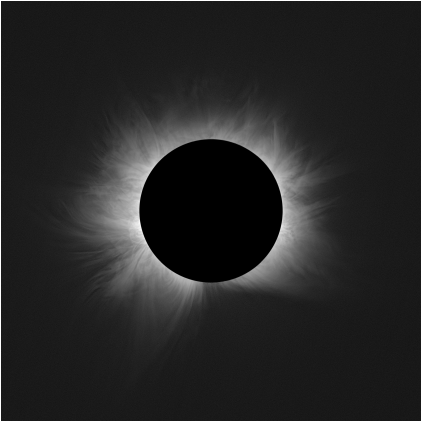
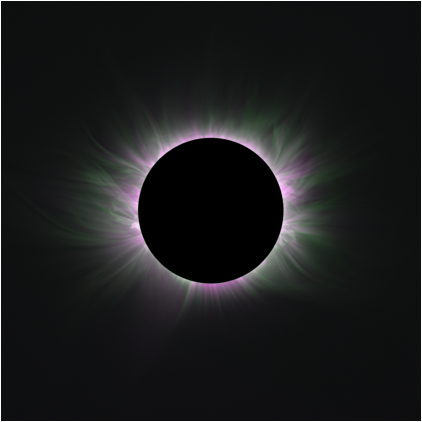
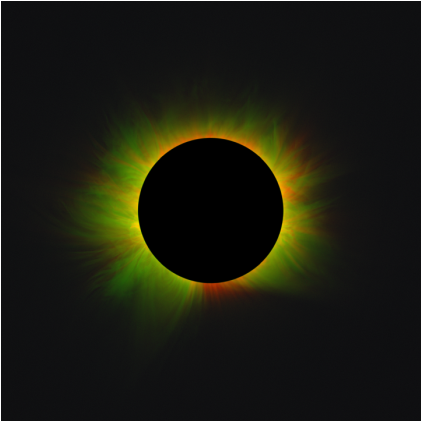
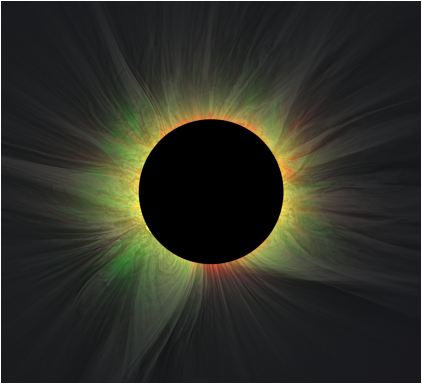
|
Narrow-band images
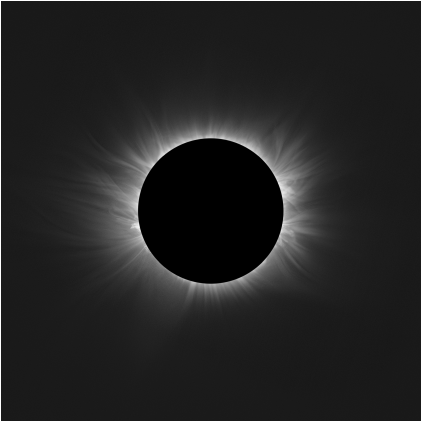
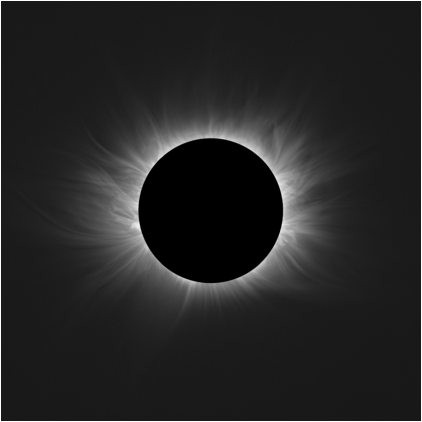
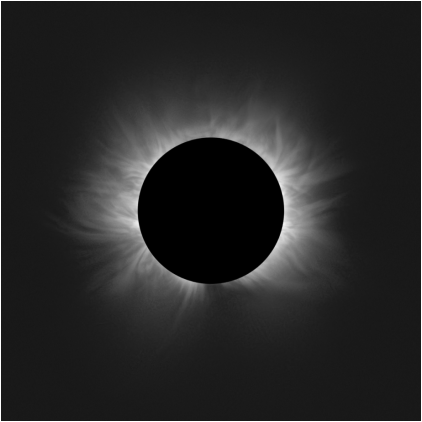
Shadow Tracking Expedition of Solar Wind Sherpas observed emission of four iron ions:
Fe X, Fe XI, Fe XIII, Fe XIV. Spectral lines of these ions are in visible and near-IR
part of the spectrum in which Earth athmosphere is transtarent and Si CCD or CMOS chip are sensitive.
Unfortunatelly there is no suitable Fe XII line in the spectral range which is observable from the Earth
surface. Fe ions provide an excellent diagnostic tool for probing the physics of the solar corona.
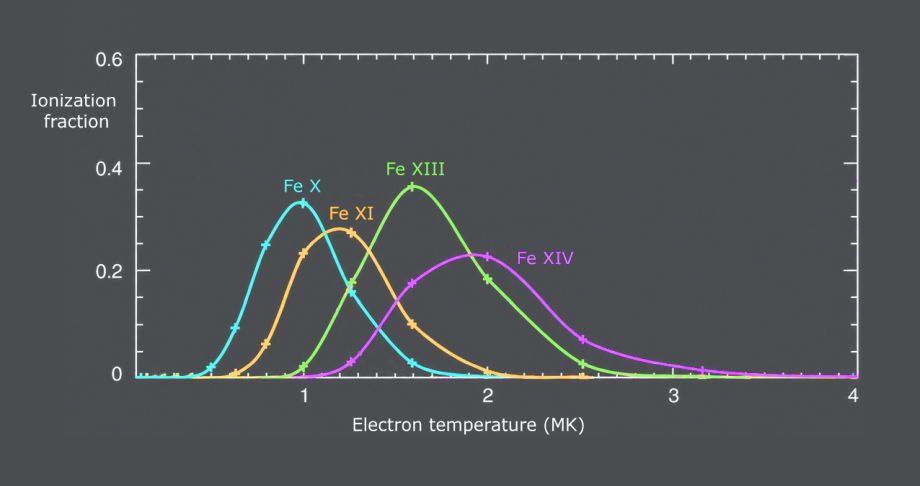
The main reason is obvious from the following graph which shows that each ion has
its typical formation temperature.
Even though all observed spectral lines are relatively strong it is not easy to
obtain images of Fe ions emission. It is not as simple as deep sky photography of
emission nebulae where only sufficiently narrow band filter is needed to isolate
the emission line. The light of the solar corona is dominated by continuum -
photospheric light scattered on free electrons. The light emitted by different
atoms and ions is very weak relative to the continuum. Using of extremely
narrow-band filters is not correct solution of the problem, on the contrary it
makes the problem even worse because these emission lines are thermally broadened
and shifted by Doppler effect. Therefore it is necessary to use pairs of filters.
One filter (on-band filter) must have transmission centered on emission line
wavelength and the transmission of the second one (off-band filter) must be in
continuum. The final image is created by subtracting the second image from the
first one. Precise photometric calibration of all images is necessary as well as
finding of correct images weights.

|
Miloslav Druckmüller
Institute of Mathematics, Faculty of Mechanical Engineering
Brno University of Technology, Czech Republic
druckmuller@fme.vutbr.cz
|
Page last update: 3.11.2026
|