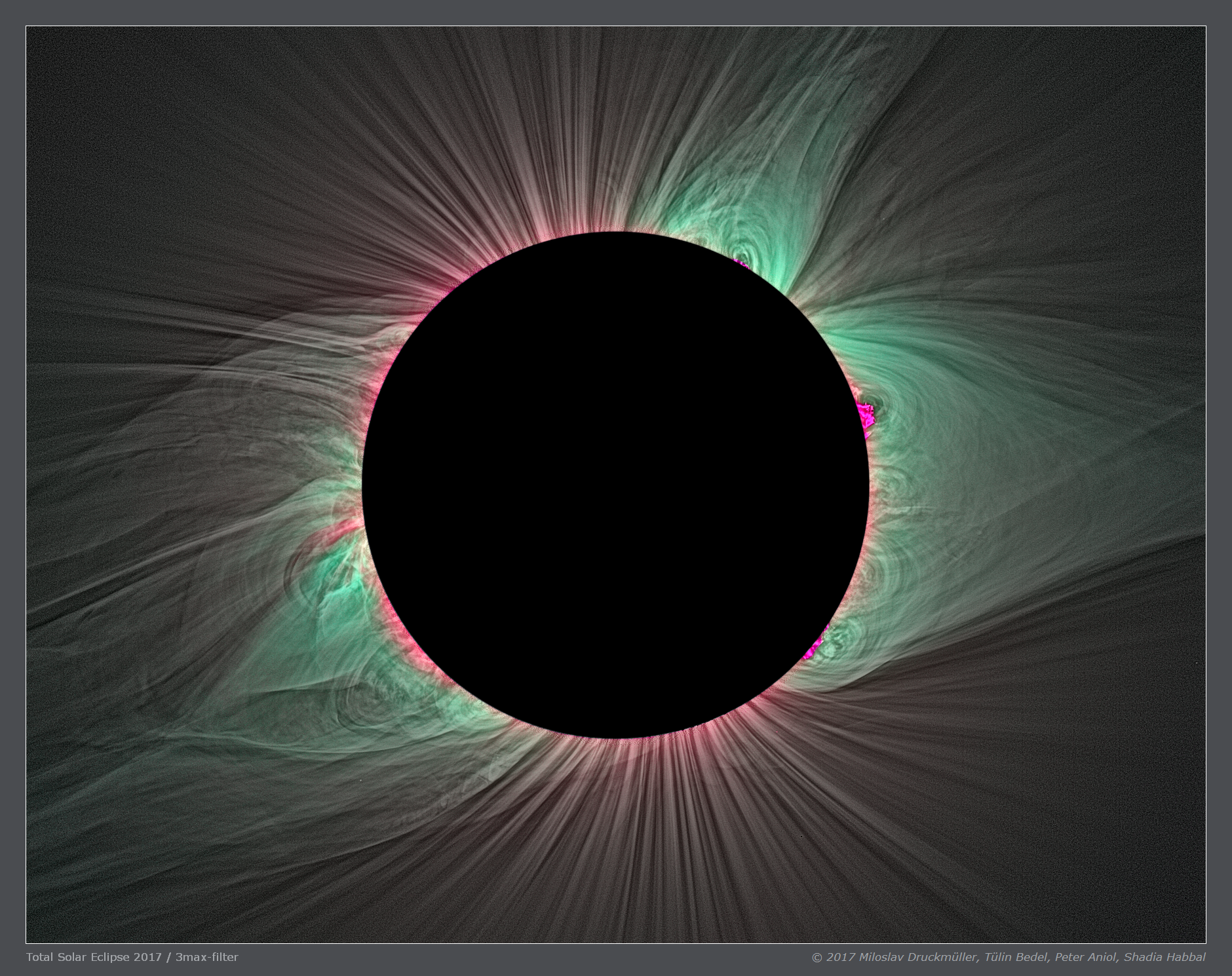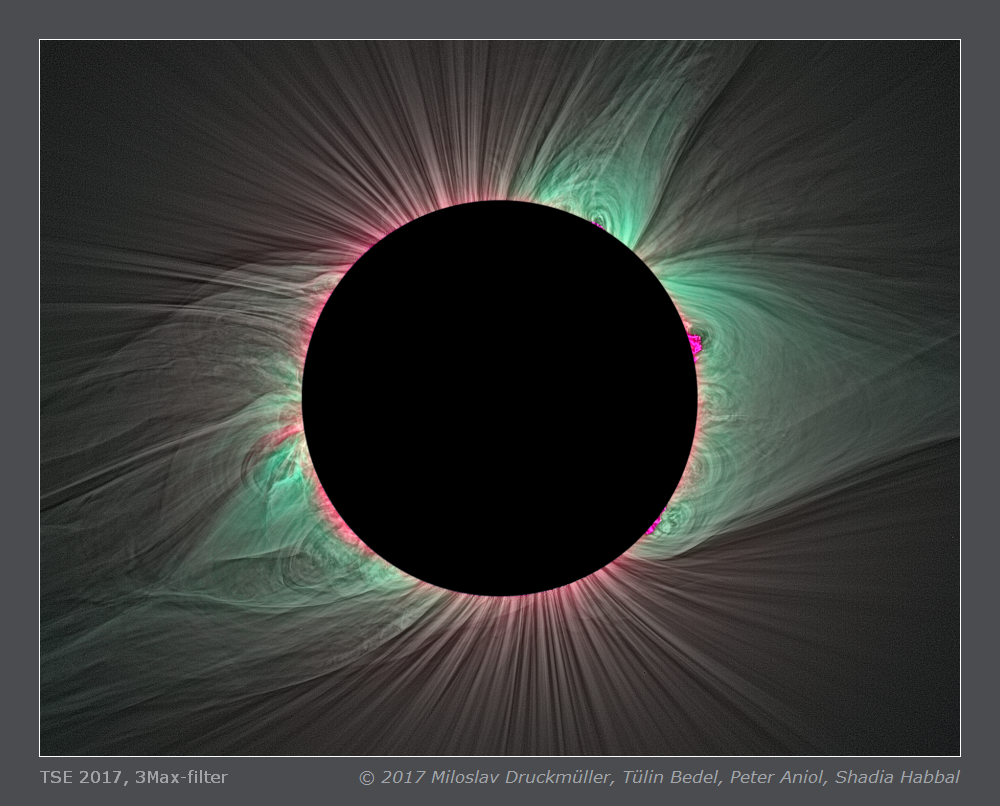
Fe XIV 530.3 nm, Fe X 637.4 nm and continuum image
This image is analogous to this one.
The difference is that the lower ionization state of iron is not Fe XI (infrared 789.2 nm line)
but Fe X (red 637.4 nm line). However completely different is the method how this image was
created. This image is a composition of 121 eclipse images acquired with APO 800 mm
lens and Nikon D810a camera equipped with special BR01-3max-Cont/FeXIV/FeX filter. This filter was
designed and manufactured at Institute of Scientific Instruments, The Czech Academy of Sciences in Brno,
Czech Republic. The filter has three maxima of transmission - blue continuum 447.5 nm,
green Fe XIV 530.3 nm line and red Fe X 637.4 nm line. This filter enables
to change Nikon D810a (or another color camera with rectangular IR-UV cut filter) to narrow band color
camera which enhances Fe XIV and Fe X emission by factor about 12. The final image is obtained
by software developed at Institute of Mathematics, Faculty of Mechanical Engineering, Brno University od
Technology which enables to create the resulting image of Fe XIV and Fe X with arbitrary
amount of continuum.
The colors of Fe XIV and Fe X are identical as in reality so
the resulting image is in the pricipal a true-color image with extremely enhanced saturation. Prominences
are highly attenuated in intensity but they have their natural colors as well.
Charged particles are tracers of magnetic field lines. At present, they are the only
tools available to visualize the 'shape' of magnetic field lines in the solar corona, thus yielding
an image of their distribution in the plane of the sky. However, there are limitations when using
ions, such as Fe X and Fe XIV, since they populate different magnetic structures with different
temperatures. Hence, the image of solar magnetic field structures, which they provide, is incomplete.
Fortunately, free coronal electrons, scattering the photospheric light towards the observer, are
omnipresent and therefore the visualization the solar magnetic filed in the white-light (continuum)
image is detailed and complete. That is why the composition presented in this page provides valuable
information about the structure of the solar magnetic field and at the same time visualizes the
distribution of Fe ions.
Click on the image or on the following reference to display the
higher resolution image version (3.8 MB, PNG format).
|
| Image | Tse_2017_3max_Alliance.png |
| Date | 21. 08. 2017 |
| Time | 2nd contact 17:48:57 UT, 3rd contact 17:51:27 UT |
| Place | Alliance, Nebraska, USA |
| Coordinate | N 42° 5.4', W 103° 0.4', Alt. 1234 m |
| Conditions | Clear sky, solar altitude 56.6° above horizon |
| Optics | TS Photo Line Apochromatic Triplet D=115 mm, f = 800 mm with 2.5 inch flattenerBR01-3max-Cont/FeXIV/FeX filter |
| Camera | Nikon D810a, ISO 200 |
| Exposure | 1/250 s - 1 s |
| Processing | Composition of 121 eclipse images. Eclipse images were calibrated by means of dark frames and flat-fields, aligned by means of phase correlation, composed by means of LDIC 6.0 software, processed using Corona 5.0 in order to visualize coronal structures. Final processing was done using ACC 6.1 software.
Image processing by Miloslav Druckmüller |
| Software | Astro D3F 2.0, PhaseCorr 7.0, LDIC 6.0, Corona 6.0, 3Max 1.0, Sofo ACC 6.1 |
| Orientation | Image must be rotated 18.02° anti-clockwise to achieve standard orientation i.e. solar North up. |
| Copyright | © 2017 Miloslav Druckmüller, Tülin Bedel, Peter Aniol, Shadia Habbal |

|
Miloslav Druckmüller
Institute of Mathematics, Faculty of Mechanical Engineering
Brno University of Technology, Czech Republic
druckmuller@fme.vutbr.cz
|
Page last update: 26.11.2019
|
|